Oh man, I'm not even sure where to begin on this post. I've learned so much in this class. This is the class that opened my eyes on how to apply these educational concepts to music. Not just concepts from this class, but from others.
In the oral final, I discussed how to apply comprehension instruction to rehearsal through using well structured warm ups that ease students into more challenging passages in their numbers, using background knowledge to help students make predictions reviewing concerts and discussing what went well and what didn't. The thing is, many music teachers do this already, but we don't know that what we are doing is "comprehension instruction" or that when we incorporate a wide variety of music at varying difficulties it's "differentiation." We just know that it's good to do it and so we do.
Now the biggest hurdle we have to get past is finding the time to do all this and rehearse. It would be nice if all we needed to do was teach basic music and how to sing or play an instrument, but we have to perform as well. I'm not begrudging performance. I love it! Why else would I have stayed in choir and then majored in it? But I feel like it's harder for us to do it all. I know for a fact that my high school choir director (who was heralded as a fantastic director, who won awards for being such a great teacher, who produced and directed extravagant, spectacular musicals each year) didn't even sort of incorporate these things into her lessons plans. She was all about rehearsal and making sure everyone sang the right note at the right time at the right dynamic with the right vowel. Why do I bring this up? She was seen as one of the most successful directors in my district, but she didn't even cover a fourth of the state standards. It's just a weird dynamic going on with music education that I still am trying to grasp.
To ideally use all of the techniques I've learned this semester (and past semesters) I feel like I'd have to have several non-rehearsal periods so I could teach history, appreciation, theory, and songwriting among others. But that when would I be able to rehearse my choirs? It may get to the point where we would need more choir directors than one per school. Gasp! Imagine that! (Actually in the midwest and Texas that's not uncommon. Actually it's not uncommon to have vocal coaches/teachers on staff as well as choreographers, professional accompanists, and assistants! And people wonder why I would ever want to leave Utah which makes me fight for the existence of my job.
Sorry, I got off on a tangent. The way I see this truly incorporating this into my teaching style in an ensemble setting is to have 10-20 minutes (depending on length of a period) devoted to teaching music concepts, studying musical texts (that aren't our repertoire), and historical information. And then dive into rehearsal for the rest of the time, because that is what music teachers are judged mostly on. The performance of our students (which other subjects are just now feeling). I know Marcia Neel has structured classes this way in Nevada, where music is a core subject (I mean really, come on Utah. Get with it!) I imagine me using the same structure while still incorporating as much as I can to the rehearsal portion as mentioned at the beginning of this post.
Wednesday, May 1, 2013

Tuesday, April 23, 2013
Self-Selected Project
I chose to read two high-interest texts from the music content area, specifically musical theatre. I also had my neighbor read these texts. Afterwards, we sat down and had our own mini "book club." Our first text was the libretto from the musical, The Secret Garden.
My neighbor and I have very similar feelings on almost everything, so it wasn't surprising that we both had many of the same thoughts on The Secret Garden. We discussed what we did and didn't like about the books. We felt that it could have been clearer as to what was going on (a way to fix this with students is to provide some scaffolding before reading). I feel like staging would have helped solve this, and this particular libretto had no stage notes so we were left with just the dialogue (with occasional soliloquy). The ghosts seemed too present, we weren't sure if it was going for deux ex machina or not. We could have done with a little less from the dead people. In the musical, they sort of teach how to speak "yorkshire." We both felt that was pretty cool and it was a good way to separate the servants from the homeowners. We weren't sure by the end whether or not Dr. Craven actually wanted the house or not. The characters themselves were very round and dynamic. You can see a lot of growth in all the main characters. The servants were used as instruments to accomplish that goal.
The way to use this in classroom instruction would depend on the class, but for a music history class we could do a unit on American musical theatre. We could aslo use this as a style of music for music appreciation. And lastly it would fit perfectly in a musical theatre class.
Allen (my neighbor) said he enjoyed reading this literature, but he was burnt out by the end. He doesn't see himself reading again too soon. What was really nice about the libretto is that it allows the reader to get a story in a very short amount of time.
There are so many ways to integrate this into a classroom. We could do basic book reports, or we could chose a selection and perform it. Have students' write a character analysis. Compare their project with others while providing constructive criticism to peers. We could also put on a variety show, showcasing the student's hard work.
We also looked at the vocal selections from The Lion King. Things that excited us are: Rafiki has a song (and it's a really good song)! This particular setting of the musical is more geared toward adults as opposed to the movie. There is a wide range of difficulty that allows students' to push themselves. There are a few really grant african chant numbers. This production also has more focus on the ensemble than the movie.
This book could be used in classroom by letting students' search through it and pick their solo work. They could aslo use their songs to create a variety show which would could use as a fund raiser (as part of a dinner and a show type thing). They could also use this book as a means to find music for their bi-termly project (a self-selected project that they need to complete twice each term). This would also be great music to create a song analysis from.
As for reading for pleasure, this is definitely a favorite. As Allen said, "It was fantastic! Music is fun!" It was fun to see the similarities and differences between the book and the 90's film. Even the differences between the book and the original broadway cast! The characterizations that the choose to add are awesome!
While speaking with Allen, we discussed how fun and complex the rhythms were for The Lion King and we talked about how we could use those rhythms as dictations for the class. Since they are so difficult, I probably would keep them for extra credit until they are more used to rhythm dictations. But if they got comfortable enough with rhythm dictations to do The Lion King ones, it would be a great indicator as to how far they have come.
My neighbor and I have very similar feelings on almost everything, so it wasn't surprising that we both had many of the same thoughts on The Secret Garden. We discussed what we did and didn't like about the books. We felt that it could have been clearer as to what was going on (a way to fix this with students is to provide some scaffolding before reading). I feel like staging would have helped solve this, and this particular libretto had no stage notes so we were left with just the dialogue (with occasional soliloquy). The ghosts seemed too present, we weren't sure if it was going for deux ex machina or not. We could have done with a little less from the dead people. In the musical, they sort of teach how to speak "yorkshire." We both felt that was pretty cool and it was a good way to separate the servants from the homeowners. We weren't sure by the end whether or not Dr. Craven actually wanted the house or not. The characters themselves were very round and dynamic. You can see a lot of growth in all the main characters. The servants were used as instruments to accomplish that goal.
The way to use this in classroom instruction would depend on the class, but for a music history class we could do a unit on American musical theatre. We could aslo use this as a style of music for music appreciation. And lastly it would fit perfectly in a musical theatre class.
Allen (my neighbor) said he enjoyed reading this literature, but he was burnt out by the end. He doesn't see himself reading again too soon. What was really nice about the libretto is that it allows the reader to get a story in a very short amount of time.
There are so many ways to integrate this into a classroom. We could do basic book reports, or we could chose a selection and perform it. Have students' write a character analysis. Compare their project with others while providing constructive criticism to peers. We could also put on a variety show, showcasing the student's hard work.
We also looked at the vocal selections from The Lion King. Things that excited us are: Rafiki has a song (and it's a really good song)! This particular setting of the musical is more geared toward adults as opposed to the movie. There is a wide range of difficulty that allows students' to push themselves. There are a few really grant african chant numbers. This production also has more focus on the ensemble than the movie.
This book could be used in classroom by letting students' search through it and pick their solo work. They could aslo use their songs to create a variety show which would could use as a fund raiser (as part of a dinner and a show type thing). They could also use this book as a means to find music for their bi-termly project (a self-selected project that they need to complete twice each term). This would also be great music to create a song analysis from.
As for reading for pleasure, this is definitely a favorite. As Allen said, "It was fantastic! Music is fun!" It was fun to see the similarities and differences between the book and the 90's film. Even the differences between the book and the original broadway cast! The characterizations that the choose to add are awesome!
While speaking with Allen, we discussed how fun and complex the rhythms were for The Lion King and we talked about how we could use those rhythms as dictations for the class. Since they are so difficult, I probably would keep them for extra credit until they are more used to rhythm dictations. But if they got comfortable enough with rhythm dictations to do The Lion King ones, it would be a great indicator as to how far they have come.
Thursday, March 21, 2013
Digital Literacy
I charted my use of technology for two weeks and I have come to the conclusion that I use them far too often. I had technology with me almost 24/7! I had my phone with me throughout the day and next to me at night. There was one day while I was in Dallas that my phone went dead around 10:30 in the morning and I was cut off from my group for the rest of the day. I used my phone as a way to fill in boring bits of the day, connect me to others (near or far), to do quick research, log onto email, use as digital boarding passes and concert tickets, etc. I had my ipod as well. I had that playing during most spaces of free time. I don't usually use it as much, but I used it as a tool to help me memorize my recital pieces. I also used it with my mikey attachment to record lectures and accompaniments. As for my laptop, I use it almost constantly. As background music, to watch T.V. or movies, to use social networks, to do research, to write papers, to write blogs about my technology use ;)
Pretty much, technology is integrated into our lives (at least mine) and is continuing to become more so. I'm almost always online in some way or another. My reprieves from screens include practicing (and even then I often use a computer or my phone as a metronome or accompaniment) and sleep. I know that I use technology a bit more than others, but I use it productively most of the time.
Online texts I have read include a few tweets, facebook statuses, journal articles, blogs, classic novels, etc. I exchange emails, tweets, and statuses with friends, colleagues, future employers, experts in my field, and others.
I would love to use technology in my class. One way that I've really liked while attending conventions, is this software called Smartmusic. It helps me fill a lot of the standards I need to encompass while still getting in rehearsal time. I can have kids go into a room and record themselves singing and the computer program will grade them on note accuracy and rhythm. I can use it for sight singing or testing on pieces we will be performing. The students can also use it for practice. It seems like a great technology that would make things much easier as an educator to fill all those standards. It also shows each student's progress and shows them what they missed and how I as a grader wasn't being subjective (which happens in music).
In a history or appreciation class, I could find countless online articles for them to read about composers and the like. In my choir class, I could help them develop videos for an Eric Whitacre virtual choir. It's a simple process and I could set up a practice room to streamline it. I would love to use edmodo or something similar to keep them updated with announcements and such, but I'm not sure that they would log in every day to see it.
The biggest technologies I see changing how I do things are Smartmusic, or Gradecam, or those test writing/grading websites. Most technologies I'd like to use are used here at the school and not at their home. They could easily ask me questions, but as I demoed some of this tech, it was very simple and basic. It was set up to be hard to not be able to do right.
I'm excited to get out there and teach and when I look at the technology developing for my field, I just get more and more excited!
Pretty much, technology is integrated into our lives (at least mine) and is continuing to become more so. I'm almost always online in some way or another. My reprieves from screens include practicing (and even then I often use a computer or my phone as a metronome or accompaniment) and sleep. I know that I use technology a bit more than others, but I use it productively most of the time.
Online texts I have read include a few tweets, facebook statuses, journal articles, blogs, classic novels, etc. I exchange emails, tweets, and statuses with friends, colleagues, future employers, experts in my field, and others.
I would love to use technology in my class. One way that I've really liked while attending conventions, is this software called Smartmusic. It helps me fill a lot of the standards I need to encompass while still getting in rehearsal time. I can have kids go into a room and record themselves singing and the computer program will grade them on note accuracy and rhythm. I can use it for sight singing or testing on pieces we will be performing. The students can also use it for practice. It seems like a great technology that would make things much easier as an educator to fill all those standards. It also shows each student's progress and shows them what they missed and how I as a grader wasn't being subjective (which happens in music).
In a history or appreciation class, I could find countless online articles for them to read about composers and the like. In my choir class, I could help them develop videos for an Eric Whitacre virtual choir. It's a simple process and I could set up a practice room to streamline it. I would love to use edmodo or something similar to keep them updated with announcements and such, but I'm not sure that they would log in every day to see it.
The biggest technologies I see changing how I do things are Smartmusic, or Gradecam, or those test writing/grading websites. Most technologies I'd like to use are used here at the school and not at their home. They could easily ask me questions, but as I demoed some of this tech, it was very simple and basic. It was set up to be hard to not be able to do right.
I'm excited to get out there and teach and when I look at the technology developing for my field, I just get more and more excited!
Thursday, February 28, 2013
Affective Dimensions of Writing
So I don't mean to go in order, but the prompts I want to do just happen to be. I'll switch it up next time. Promise.
My experience as a writer is limited. And I don't consider myself much of one. Most of my writing is for myself. I have kept a journal off and on since I was in second grade. I keep a notepad near my bed so that I can write what comes to me right before I sleep since I feel that is when I get the most random moments of clarity (and if I don't write them down, my brain will refuse to go to sleep). I actually have written a book that has been left unfinished for years. It stands at 300 pages right now and I'd like to get it bound one day. I have also kept this blog and another (I'm more consistant on the other). Most of my emails are business related, but since I have friend's across the world right now, I do send them snail mail every once in a while. When I write Facebook status updates, I try to put thought into them, not just, "I'm eating a sandwich."
I like to express my ideas and emotions numerous ways. It depends on my mood. For some subjects, I will write about it (those seem to be the complex yet concrete things I can apply logic to). Harder topics that I'm not quite sure how to express my thoughts on, will be dealt with some major doodles. The more emotional ideas will be express through music. I'll arrange or write a diddy or two here and there, but mostly I'll find a piece or song that fits what I'm going through and will play or sing it until I feel satisfied.
Whenever I can think of a writing assignment I actually enjoyed, it was always about a subject that I enjoyed. The subject material was usually picked by me. I talked about this particular experience in class, but I'll use it again because I really enjoyed it.
In an English class we had to do book reports for books that we were reading on our own. The book I read was Bram Stoker's Dracula. My teacher gave us a list of different ways we could do our book report and I chose to write the front page of the paper that could be printed during the plot of the book. I was able to write about an abandoned ship found out in the sea, an attack on a local girl, and all the crazy things that happen in Dracula. It was a perfect book for this project. It was fun to act as reporter and editor for a fictitious newspaper. This project allowed us to be creative and I like how we got to decide how to present the knowledge we gained while reading.
When I think of writing assignments that I hated (and that is to put it mildly) it actually comes from the same class. We had to put together a poetry anthology. We had to write 10 poems and analyze 10. It doesn't sound too bad, but my teacher assigned it during the busiest time of the school musical on purpose because she hated how much attention it got when the debate team was practically ignored (I'm not making assumptions, she right out told us that is why she picked the date). Most of my poems I wrote spoke about how much I didn't appreciate what she did to us and how terrible of a teacher that made her (that could have bit me in the butt, but luckily I still got an A).
When I assign writing assignments, I would like to leave a lot up to the students to decide. It helps them write about something they care about or in a way that they might enjoy it. I also plan on not following the example of my teacher and being vindictive when choosing due dates. And this goes beyond writing. I would like to make as much as I can personalized towards the students. I want them to have the opportunity to perform, compose, analyze, etc. what interests them. This is something I've planned to have in my curriculum since the get-go.
My experience as a writer is limited. And I don't consider myself much of one. Most of my writing is for myself. I have kept a journal off and on since I was in second grade. I keep a notepad near my bed so that I can write what comes to me right before I sleep since I feel that is when I get the most random moments of clarity (and if I don't write them down, my brain will refuse to go to sleep). I actually have written a book that has been left unfinished for years. It stands at 300 pages right now and I'd like to get it bound one day. I have also kept this blog and another (I'm more consistant on the other). Most of my emails are business related, but since I have friend's across the world right now, I do send them snail mail every once in a while. When I write Facebook status updates, I try to put thought into them, not just, "I'm eating a sandwich."
I like to express my ideas and emotions numerous ways. It depends on my mood. For some subjects, I will write about it (those seem to be the complex yet concrete things I can apply logic to). Harder topics that I'm not quite sure how to express my thoughts on, will be dealt with some major doodles. The more emotional ideas will be express through music. I'll arrange or write a diddy or two here and there, but mostly I'll find a piece or song that fits what I'm going through and will play or sing it until I feel satisfied.
Whenever I can think of a writing assignment I actually enjoyed, it was always about a subject that I enjoyed. The subject material was usually picked by me. I talked about this particular experience in class, but I'll use it again because I really enjoyed it.
In an English class we had to do book reports for books that we were reading on our own. The book I read was Bram Stoker's Dracula. My teacher gave us a list of different ways we could do our book report and I chose to write the front page of the paper that could be printed during the plot of the book. I was able to write about an abandoned ship found out in the sea, an attack on a local girl, and all the crazy things that happen in Dracula. It was a perfect book for this project. It was fun to act as reporter and editor for a fictitious newspaper. This project allowed us to be creative and I like how we got to decide how to present the knowledge we gained while reading.
When I think of writing assignments that I hated (and that is to put it mildly) it actually comes from the same class. We had to put together a poetry anthology. We had to write 10 poems and analyze 10. It doesn't sound too bad, but my teacher assigned it during the busiest time of the school musical on purpose because she hated how much attention it got when the debate team was practically ignored (I'm not making assumptions, she right out told us that is why she picked the date). Most of my poems I wrote spoke about how much I didn't appreciate what she did to us and how terrible of a teacher that made her (that could have bit me in the butt, but luckily I still got an A).
When I assign writing assignments, I would like to leave a lot up to the students to decide. It helps them write about something they care about or in a way that they might enjoy it. I also plan on not following the example of my teacher and being vindictive when choosing due dates. And this goes beyond writing. I would like to make as much as I can personalized towards the students. I want them to have the opportunity to perform, compose, analyze, etc. what interests them. This is something I've planned to have in my curriculum since the get-go.
Thursday, February 14, 2013
Connection to Home Experiences
I have been involved with my content area (Music) for a very long time. My mother is a piano teacher and, to my knowledge, has been since before I was born. Either way, I know that one way or another, the moment I developed ears and gained the ability to hear, I was exposed to music.
I started piano lessons when I was five. My sister tutored me on the violin when I was six. My other sister taught me the basics of the flute when I turned eight. I snuck into my brother's room and would noodle on his guitar when he wasn't home. When I was in fourth grade I landed the lead role in the school musical: Scrooge. In fifth grade I joined the Salt Lake Children's choir. Then, in sixth grade, I picked up the cello and joined orchestra. In eighth grade I joined my junior high's choir. That same year I began to teach piano lessons.
I wasn't just involved with lessons and ensembles, though. I loved to write my own music. I entered a few competitions and won! (There weren't many competitors, though...) I have been in almost a dozen musicals and seen countless others, including a handful of operas. And let's not forget the numerous Disney movies I watched over and over again and would sing along to (still do, by the way).
These experiences definitely guided me to choose my major. I loved learning! Every time I could grab hold of a new instrument, a new experience, I would. The experiences that stand out above the rest are my experiences with musicals. I feel such a connection to the characters and text of each musical. I am a pretty empathetic person and the emotion that composers write into their music and characters impacts me. I think it was those waves of emotion that drew me to music. I learned from those characters, their experiences. Nothing was more powerful to me then when a character broke out into a sililoquial (Yes... I made that word up) song as they had reached a turning point in their lives. (Ex. Elphaba when she sings Defying Gravity. Millie when she sings Gimme, Gimme. Percy when he sings Prayer and later She was There.)
This is one major reason I chose to emphasize with choir. So I could be involved with the musical. I wanted to show students what these connections can do for them in their lives. I want them to feel what I've felt. That is what drew me to music.
Now that I've grown a bit, I've realized that it's not just musicals that can do this. It's different for each student, but it falls to me to find what it is for my students that draws them to music. They could love opera or jazz choir. I need to find it for them. I need to expose them to it. So they can find their "jam."
I started piano lessons when I was five. My sister tutored me on the violin when I was six. My other sister taught me the basics of the flute when I turned eight. I snuck into my brother's room and would noodle on his guitar when he wasn't home. When I was in fourth grade I landed the lead role in the school musical: Scrooge. In fifth grade I joined the Salt Lake Children's choir. Then, in sixth grade, I picked up the cello and joined orchestra. In eighth grade I joined my junior high's choir. That same year I began to teach piano lessons.
I wasn't just involved with lessons and ensembles, though. I loved to write my own music. I entered a few competitions and won! (There weren't many competitors, though...) I have been in almost a dozen musicals and seen countless others, including a handful of operas. And let's not forget the numerous Disney movies I watched over and over again and would sing along to (still do, by the way).
These experiences definitely guided me to choose my major. I loved learning! Every time I could grab hold of a new instrument, a new experience, I would. The experiences that stand out above the rest are my experiences with musicals. I feel such a connection to the characters and text of each musical. I am a pretty empathetic person and the emotion that composers write into their music and characters impacts me. I think it was those waves of emotion that drew me to music. I learned from those characters, their experiences. Nothing was more powerful to me then when a character broke out into a sililoquial (Yes... I made that word up) song as they had reached a turning point in their lives. (Ex. Elphaba when she sings Defying Gravity. Millie when she sings Gimme, Gimme. Percy when he sings Prayer and later She was There.)
This is one major reason I chose to emphasize with choir. So I could be involved with the musical. I wanted to show students what these connections can do for them in their lives. I want them to feel what I've felt. That is what drew me to music.
Now that I've grown a bit, I've realized that it's not just musicals that can do this. It's different for each student, but it falls to me to find what it is for my students that draws them to music. They could love opera or jazz choir. I need to find it for them. I need to expose them to it. So they can find their "jam."
Tuesday, January 15, 2013
Introduction Post for SCED 4200
Hello! My name is Andrew Moon. I started this blog long ago and its purpose has morphed quite a few times. But I've kept the title for a very long time since I believe it fits quite well. And now I get to use this space for a class entitled Language, Literacy, and Learning in the Content Areas. I'm excited that I have something to breathe some life back into this thing, and perhaps I'll continue blogging more regularly. (I'm sure my family will appreciate it).
Well, let's talk about me! Let's start with some random quick facts: I got glasses because I wanted a dog (long story). I have still have some random memories from when I was two or three. I pick up on most skills really quickly, but it takes me longer than most to master any. I ran away from elementary school three times (prime example for my avoidant personality). I usually dislike when people ask me about my hobbies and interests since the first thing to come to mind is MUSIC! Since it is my major most people don't count it as a hobby, but I'll have to disagree with that sentiment. It may be a different type of music, but music is my life blood. Nothing moves me more than a random passage from a sonata here, an aria there, or--heaven forbid-- a musical theatre anthem (I say heaven forbid only because musical theatre is seen as fluff to many in the music world).
When I was sixteen, I attended early college at Weber State, fully planning to move into pre-med, I was sitting in one of my basic chemistry labs and while I found it interesting--maybe a little fun--I realized that I didn't want to do medicine or any form of science day in and day out. I didn't feel like I could do it every day and feel accomplished. I wanted to change people's lives.
I did some intense soul searching, trying to figure out what it was that could give me everything I desired from a profession. I came to a conclusion: be a Choir Teacher. That answer terrified me. I remember in second grade I told my parents I wanted to become a teacher and they answered with an immediate and resounding, "No." They simply didn't get paid enough. I think that was a large part of why I aimed to be a doctor. I didn't want to tell my parents I had changed my mind and wanted to be a teacher again, but I did and it's taken a little bit, but they're supportive of the idea... mostly.
So let's dive into literacy. Literacy is a tricky concept. Yes, reading and writing is great, but there's more to it. To be truly literate is to think for oneself and be able to find truth where there is some to be found and be able to weed out untruths. But don't do so without being considerate for other people's truth. (I hope some of that made sense).
As for what I wish to teach the class, I have no idea. I hope that these ramblings turn into something concrete that others can learn from. I hope to find ways to apply this class to music since I feel most of these SCED classes have been applicable to most disciplines, but not mine. The fact is, music is an entirely different monster. I beautiful, wonderful monster.
Well, let's talk about me! Let's start with some random quick facts: I got glasses because I wanted a dog (long story). I have still have some random memories from when I was two or three. I pick up on most skills really quickly, but it takes me longer than most to master any. I ran away from elementary school three times (prime example for my avoidant personality). I usually dislike when people ask me about my hobbies and interests since the first thing to come to mind is MUSIC! Since it is my major most people don't count it as a hobby, but I'll have to disagree with that sentiment. It may be a different type of music, but music is my life blood. Nothing moves me more than a random passage from a sonata here, an aria there, or--heaven forbid-- a musical theatre anthem (I say heaven forbid only because musical theatre is seen as fluff to many in the music world).
When I was sixteen, I attended early college at Weber State, fully planning to move into pre-med, I was sitting in one of my basic chemistry labs and while I found it interesting--maybe a little fun--I realized that I didn't want to do medicine or any form of science day in and day out. I didn't feel like I could do it every day and feel accomplished. I wanted to change people's lives.
I did some intense soul searching, trying to figure out what it was that could give me everything I desired from a profession. I came to a conclusion: be a Choir Teacher. That answer terrified me. I remember in second grade I told my parents I wanted to become a teacher and they answered with an immediate and resounding, "No." They simply didn't get paid enough. I think that was a large part of why I aimed to be a doctor. I didn't want to tell my parents I had changed my mind and wanted to be a teacher again, but I did and it's taken a little bit, but they're supportive of the idea... mostly.
So let's dive into literacy. Literacy is a tricky concept. Yes, reading and writing is great, but there's more to it. To be truly literate is to think for oneself and be able to find truth where there is some to be found and be able to weed out untruths. But don't do so without being considerate for other people's truth. (I hope some of that made sense).
As for what I wish to teach the class, I have no idea. I hope that these ramblings turn into something concrete that others can learn from. I hope to find ways to apply this class to music since I feel most of these SCED classes have been applicable to most disciplines, but not mine. The fact is, music is an entirely different monster. I beautiful, wonderful monster.
Friday, March 25, 2011
Day 1: Leaving On a Jet Plane
Alright, so I decided that I would go through this trip day by day. It just seemed easier that way. Besides, it's how Camille does it and she seems like the experienced travel blogger. Oh and Day 1 is going to include the day before as well...
And so my first trip outside of the U.S. begins. Heck, my first trip East of Flaming Gorge begins (I know, pathetic). On Thursday I finished class, ran back to my apartment, and grabbed everything I would need for my trip. I had done laundry the day before, but since I didn't have any luggage up here, I would have to pack everything in Centerville the night before. I drove down to Centerville making a quick stop in Brigham City to pick up Tara.
We arrived in Centerville and I set out packing. I finished relatively quickly and then we headed to Chili's for dinner. Then we headed to Viewmont to watch my all-time favorite musical: The Scarlet Pimpernel. It was the first time Tara had seen it and she loved it! It was just the dress rehearsal, but we crashed it since there was no other way to see it since it played only during the Italy trip. It was also Ms. M's public announcement that this is her last year teaching at Viewmont.
The next morning we headed to the airport. We were incredibly early and so we headed back to Zion's bank to exchange dollars for euros. And while there, mom and dad brought a jacket that I had left (I did not ask them to, they just came anyway. I even told them not to bother, but they were already on their way). So we went back through security.
The next 4 hours in that plane were probably the worst 4 hours of the trip. I was stuck between two others and one was a large person like myself. It was cramped and I didn't sit next to people I really knew. I was also dehydrated but yeah...
We hopped out that plane and ran literally to the other side of the airport. When we got there, I called Camille to wish her a happy birthday a day early. Then we hopped on the plane and Tara and I, through some careful maneuvering and convincing, were able to sit by each other. This made the flight MUCH better than the first. Also the seats are a tad bigger and they work harder to keep you more comfortable, which was what I needed. I cracked open some books to study but nothing was sticking at all. So I took a little snoozer. I woke up and watched a bit of The Social Network. I kept waiting for The King's Speech since it was announced that it would play... but it never did. :'(

We reached Rome and grabbed our bags and went through customs. The process was very much like walking through a door. No, that's exactly what it was. Incredibly easy. And technically that's the end of day one. I'll post day two soon.
And so my first trip outside of the U.S. begins. Heck, my first trip East of Flaming Gorge begins (I know, pathetic). On Thursday I finished class, ran back to my apartment, and grabbed everything I would need for my trip. I had done laundry the day before, but since I didn't have any luggage up here, I would have to pack everything in Centerville the night before. I drove down to Centerville making a quick stop in Brigham City to pick up Tara.
We arrived in Centerville and I set out packing. I finished relatively quickly and then we headed to Chili's for dinner. Then we headed to Viewmont to watch my all-time favorite musical: The Scarlet Pimpernel. It was the first time Tara had seen it and she loved it! It was just the dress rehearsal, but we crashed it since there was no other way to see it since it played only during the Italy trip. It was also Ms. M's public announcement that this is her last year teaching at Viewmont.
The next morning we headed to the airport. We were incredibly early and so we headed back to Zion's bank to exchange dollars for euros. And while there, mom and dad brought a jacket that I had left (I did not ask them to, they just came anyway. I even told them not to bother, but they were already on their way). So we went back through security.
The next 4 hours in that plane were probably the worst 4 hours of the trip. I was stuck between two others and one was a large person like myself. It was cramped and I didn't sit next to people I really knew. I was also dehydrated but yeah...
We hopped out that plane and ran literally to the other side of the airport. When we got there, I called Camille to wish her a happy birthday a day early. Then we hopped on the plane and Tara and I, through some careful maneuvering and convincing, were able to sit by each other. This made the flight MUCH better than the first. Also the seats are a tad bigger and they work harder to keep you more comfortable, which was what I needed. I cracked open some books to study but nothing was sticking at all. So I took a little snoozer. I woke up and watched a bit of The Social Network. I kept waiting for The King's Speech since it was announced that it would play... but it never did. :'(

We reached Rome and grabbed our bags and went through customs. The process was very much like walking through a door. No, that's exactly what it was. Incredibly easy. And technically that's the end of day one. I'll post day two soon.
Tuesday, October 19, 2010
Why Be Anything Else?
Tonight I had a conversation with my roommate and during this conversation he alluded to an opinion that music majors had it easy while engineering majors were most assuredly the hardest major. Now, while his comments may be in jest, they reminded me of conversations I've had with others who seem to think the same thing. And while these conversations played over and over in my head, I got more upset. So I'm here to set the record straight!
 Thinking about all the majors that laid before my feet as I was trying to decide exactly what I wanted to do, I cannot help but think, "I could have been an engineering major (really, I could have)... but why do that when I can do something challenging like music?" That's right here's the little secret, a music major is hard! It's not the fluffy major that many just assume that it is. Now, some of the people I've talked about this with feel like they have a good idea of what music majors are all about because they were in the orchestra, band, or choir. Excuse me, let me just tell you that being in an ensemble does not prepare you for the riggers of a music major. (I'm going to be comparing my major to engineering only because that is what it was compared to recently and it seems to be the socially accepted "hard" major of USU)
I am willing to say that a good 50% (at least) of music majors enter into it sorely unprepared. They are a great many that I have seen come and go in the department in my almost year and a half. Okay, so I get it, engineering majors have a lot of math. It's not like we are sitting in the music building holding hands in a circle singing kumbaya all day. We are immediately dropped into an ocean of music theory and my least favorite: Aural Skills.
So there's this thing about math that in my opinion makes it kinda easy. First, there are so many different ways to find the answer to one problem. And then you learn the rules and there you go. You got it. There's math for you. Okay so here's music, while there may be slight fluctuations in actual voicing there is very little leeway in chords and progressions. And then as your analyzing something things might not make sense, but you must realize that we learn the rules and then we learn how to break the rules... wait... yeah.
Another thing to be wary of is that as you write your progressions there might be a chord that technically works, but will be marked wrong because it "sounds a bit off." How do you like that as a measurement of grading? I've never been marked down on a math problem that was done correctly, but just didn't look right.
Now how many credits are engineer major classes worth? 3-5 credits. Oh no, right? This means it's hard... but wait, think about it this way. Music major classes: 1 credit (maybe 3 if you're lucky). Classes each has to take (assuming 18 credits)... Engineering: 4-6 classes. Music Major:10-14 classes. Yeah... our days are automatically long just due to class time. (And even in the early morning we're expected to be warmed up and at the top of our game. That's why I generally get up earlier than my roommates). (And let's not forget what that means come Finals Week.) After a long day, we have the homework for those 10-14 classes. Oh and logically we must think, the 1 credit classes must be way easier... haha, not so. My hardest class has always been this 1 credit class called aural skills (you may have heard me mention it before). Ever heard the rule that however many credits it's worth is how much time spent out of class each day you should spend on it? Well, that 1 credit class usually takes 2-3 hours out of my day... oh and it has 2 finals.
Oh and if we aren't busy enough, attendance to masterclasses, on-campus performances, student recitals, guest artist recitals, and ensemble performances are required.
Okay so aside from all this is the core of any music major's curriculum. Practicing.
Holy. Freaking. Cow. You spent three hours on a math assignment? (A complaint I've heard from multiple people) I spend at minimum 5 hours a day locked away in some practice room practicing voice, piano, aural skills, guitar, or my instrument of the month. Oh, yeah that's right. Music Education majors must learn to play every instrument or at least a good number of representatives from each discipline (woodwind, brass, string, etc). I'd compare that to something in the engineering department, but to my knowledge they don't have any requirement even close.
Back to practicing, you have to be okay with being alone most of the time. We rarely can get a group together to practice. It just wouldn't make sense. We do completely different things than everyone else in our department. And you can only reserve a practice room for 1 hour/day so how do I get the other 4 in? I enter a practice room and hope that the person who has it reserved doesn't come. If they do, however, all I have to say is that I'm lucky I live in Utah and have resources like an institute with pianos in the majority of the rooms (even though most are occupied) and churches with an average of six pianos placed somewhere within (and being in Logan we have churches literally right next to each other). However even with this, you are not guaranteed anything. I've never seen an engineering major battling his fellow classmates for who gets to use the textbook next.
I could seriously go forever talking about how much more challenging music majors are than people give us credit for, but I don't want you to get the wrong idea. I LOVE my chosen major. It's definitely what I'm supposed to be doing. However, if I didn't have my passion for music, I would have changed majors long ago. It is my love and life. It is what I was "put on earth to do with such passion and such intensity that is [has] became spiritual in calling" (Van Gogh).
So let me just reiterate: Why be any other major when I can challenge myself and be a music major? But seriously, next time you see a music major, give them a hug, they need and deserve it.
I am willing to say that a good 50% (at least) of music majors enter into it sorely unprepared. They are a great many that I have seen come and go in the department in my almost year and a half. Okay, so I get it, engineering majors have a lot of math. It's not like we are sitting in the music building holding hands in a circle singing kumbaya all day. We are immediately dropped into an ocean of music theory and my least favorite: Aural Skills.
So there's this thing about math that in my opinion makes it kinda easy. First, there are so many different ways to find the answer to one problem. And then you learn the rules and there you go. You got it. There's math for you. Okay so here's music, while there may be slight fluctuations in actual voicing there is very little leeway in chords and progressions. And then as your analyzing something things might not make sense, but you must realize that we learn the rules and then we learn how to break the rules... wait... yeah.
Another thing to be wary of is that as you write your progressions there might be a chord that technically works, but will be marked wrong because it "sounds a bit off." How do you like that as a measurement of grading? I've never been marked down on a math problem that was done correctly, but just didn't look right.
Now how many credits are engineer major classes worth? 3-5 credits. Oh no, right? This means it's hard... but wait, think about it this way. Music major classes: 1 credit (maybe 3 if you're lucky). Classes each has to take (assuming 18 credits)... Engineering: 4-6 classes. Music Major:10-14 classes. Yeah... our days are automatically long just due to class time. (And even in the early morning we're expected to be warmed up and at the top of our game. That's why I generally get up earlier than my roommates). (And let's not forget what that means come Finals Week.) After a long day, we have the homework for those 10-14 classes. Oh and logically we must think, the 1 credit classes must be way easier... haha, not so. My hardest class has always been this 1 credit class called aural skills (you may have heard me mention it before). Ever heard the rule that however many credits it's worth is how much time spent out of class each day you should spend on it? Well, that 1 credit class usually takes 2-3 hours out of my day... oh and it has 2 finals.
Oh and if we aren't busy enough, attendance to masterclasses, on-campus performances, student recitals, guest artist recitals, and ensemble performances are required.
Okay so aside from all this is the core of any music major's curriculum. Practicing.
Holy. Freaking. Cow. You spent three hours on a math assignment? (A complaint I've heard from multiple people) I spend at minimum 5 hours a day locked away in some practice room practicing voice, piano, aural skills, guitar, or my instrument of the month. Oh, yeah that's right. Music Education majors must learn to play every instrument or at least a good number of representatives from each discipline (woodwind, brass, string, etc). I'd compare that to something in the engineering department, but to my knowledge they don't have any requirement even close.
Back to practicing, you have to be okay with being alone most of the time. We rarely can get a group together to practice. It just wouldn't make sense. We do completely different things than everyone else in our department. And you can only reserve a practice room for 1 hour/day so how do I get the other 4 in? I enter a practice room and hope that the person who has it reserved doesn't come. If they do, however, all I have to say is that I'm lucky I live in Utah and have resources like an institute with pianos in the majority of the rooms (even though most are occupied) and churches with an average of six pianos placed somewhere within (and being in Logan we have churches literally right next to each other). However even with this, you are not guaranteed anything. I've never seen an engineering major battling his fellow classmates for who gets to use the textbook next.
I could seriously go forever talking about how much more challenging music majors are than people give us credit for, but I don't want you to get the wrong idea. I LOVE my chosen major. It's definitely what I'm supposed to be doing. However, if I didn't have my passion for music, I would have changed majors long ago. It is my love and life. It is what I was "put on earth to do with such passion and such intensity that is [has] became spiritual in calling" (Van Gogh).
So let me just reiterate: Why be any other major when I can challenge myself and be a music major? But seriously, next time you see a music major, give them a hug, they need and deserve it.
Monday, August 16, 2010
TiMER

So I was browsing Netflix the other day and scrolled over a movie titled "TiMER." It gave me a brief summary as to what it's about. I didn't watch it, but the summary presented an idea that I thought was interesting. The movie revolves around this technology that you implant into your wrist (shown above). It's simply called a "timer." And what, do you ask, is it timing? It's a countdown to the midnight before you meet your soulmate. It can only begin the countdown once both people have been implanted and once they are in close enough proximity, both implants will beep.
Now here's the question, would you get implanted? Now, I realize that most of you are married at this point and don't really have need for this, but let's pretend we're single once again and are faced with the option of getting implanted or not. Do you leave love up to the fates? Or do you let this new matchmaking service do the job for you?
Remember: It will remain blank as long as your soulmate is not implanted. It may tell you that you won't meet your match until your sixty. What if you fall in love before you meet your destined soulmate? However, also remember that it does work, it doesn't make mistakes. You will be happy with this person... eventually if not at first (it may be an "enemies become lovers" type of deal).
Saturday, July 10, 2010
Glimpse of the Future
Okay, so I know you haven't heard from me in a while and I'm sorry about that... but I don't really have much to blog about. Perhaps I'll get around to cataloging the mundane things I do. However, the purpose is not to focus on that, but rather, the future. That's right. My future.
Well, not exactly. There's this new show you might have heard of called "Glee." That's right. I'm a total Gleek... That's right Gleek. That's how much I love this show. Anyway, so here's a clip from the season finale that I've watched about a bigillion times. I thought you guys might appreciate it as well. It showcases some songs that I had already decided my choir would sing. It's nice to see my ideas come into fruition without any work on my part. :D
I can't wait until I get to create this myself! Just wait a few years! Now it's 6 1/2 minutes, but seriously, you can spend that time to see this, because it's that awesome. So be sure to go to the right side of the page and mute the music. Now, I present to you...*small drumroll* the clip: (There will most likely be a 30 second commercial, just warning ya):
P.S. If it says something about it not being available and you might need to clear your browser cache or something like that... Just refresh. It's just a little temperamental.
Monday, May 24, 2010
Happy Birthday Dad!
As we all know, it is Dad's birthday and I had no money but I still wanted to do something. So what I did was make a birthday dinner for Dad! And since I haven't posted in several months, I decided I'd make a post of it! Well, it was slightly harder than I thought it was going to be, but that's okay. It was still a good day, just really tiring. Many of you actually already know about this since I called you for advice, tips, instructions, etc. Thank you so much for all your help!
Well, here's just a little bit of what my day was like. So I got up at 6:15 and made the dough for my baked brie. I put it in the fridge to set or rise or whatever it's supposed to do while it sits for 8 hours. Then I got out chicken so that it can thaw by the time I need to use it.

Then I made a sweet vinaigrette with honey for the salad... And the honey was kind of crystalized or something so I had to...

Well, I don't like vinaigrettes and this one didn't look all that great... well here, how about you take a look...

Vinaigrettes aren't supposed to look like that, are they? Well, actually some do... but well, they aren't exactly appetizing as it is... Well, then it was shopping for fresh ingredients!

There's the cheese's, rice, walnuts, parsley, carrots, and peas I got. (round 1 of shopping) So I made the butter horn dough and trimmed the peas. (I took out my good knives for the day. I considered this to be a good time to use them)

Then an applesauce cake with dad with walnuts and cream cheese frosting. Using Dad's favorite cookbook that has used and abused by this family longer than I've been. (I also realized I had to go back to the store and get cream cheese frosting and white grape juice... so this time I just went to Walmart.)


And the finished product...

You know what these are!
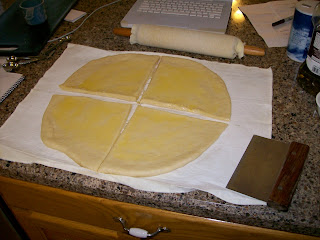
That's right! Butterhorns! (They rose to a massive size and covered that entire tray when I put them in the oven, by the way. I didn't get a picture of a baked roll, but I'm sure you've seen them enough to know what they look like :D)

Dad calls and says he's bringing our cousin Doug home for dinner... SERIOUSLY?! Of all days! Ok, what do I have? What have I made? Do I have enough? What are my limiting ingredients (or reactants as I'd call them in chemistry) and what do I need to do to get more? So with that in mind I grabbed a chicken from the freezer and make an 11th hour dash to the store a third time and get more broth for the rice pilaf.

So mom popped the breast into the microwave and I started on the glaze for the chicken. It was a honey-orange chicken so I used they honey I melted earlier and half a can of juice concentrate. Doesn't look great and actually it got a whole lot darker after I put the worcestershire sauce in.

And here they are ready to bake. I was only using the glaze from the recipe. I was trying to find a way to cook it my own way since I didn't want to do chicken chunks in a broiler (not nearly as classy). Oh and notice the breast at the back. It's a little stubbier than the rest? It's already partially cooked from being quickly "thawed" in the microwave. That's what you get when you rush things!

It was about time to set the table oh... Doug and can't come anymore... you know... after all that.

Then I made a simple rice pilaf. It had sautéed onions in it and some extra seasoning and was made with chicken broth. That's what made it a pilaf. But the goal was to not draw attention away from the main entree.

Then I clipped lettuce out of the garden. (I actually did this earlier in the morning as you can tell from the light, but I don't remember the order well anymore so...) I thought I was going to have to clip more when Doug was coming but I found out in time that I didn't have to go clipping for more lettuce.

Then I made the veggies. Carrots, snow peas, red pepper, and red onion. Top with some melted butter and salt. (colorful and actually pretty easy to make, just make sure you cook the carrots for 5-6 minutes before you add the rest since they take longer to cook)

It was time to eat! Yay!

This is the baked brie that many have wondered about. I first had it on Thanksgiving in California with the Phelps. When I said how much I liked it Bro. Phelps said, "It is good, but how can you go wrong with bread and cheese?"

Inside view of the baked brie.

Here's the salad that I made! It's just glazed walnuts with feta cheese and a strawberry on a bed of lettuce.

Here's the main course! The sauce on the chicken is that liquidy glaze that I decided to thicken with some cornstarch (I made it a little too thick, but it was okay).

And for desert...


It wasn't a perfect night as dad helped with the dishes... okay... he did the dishes and I helped. But I was exhausted and welcomed all the help I could get.

Happy Birthday Dad!
Monday, February 1, 2010
My Talk
So I gave a talk in church, which was weird since it's not necessarily my homecoming... But hey! So, I'm gonna post my talk here so you can read it if you really want. It takes about 15 minutes to read... at least out loud... :D
And so we go:
Yem Long! Jao! Sabaai-dii! Mao zhong! Namasté! Sat siri akaal! Hola! Talofa! Malo e lelei! Buh-la! Nee-how! Yawk-way! Sa-wat dee! Chum ree-uhp soo-uh! Zdravst-vwee-tye! (Sign it!) Hello!
I just wanted to start off with the greetings I used on my mission. I never really got down the right tones… but most people would understand me… or just appreciate the fact that I tried. The hardest part was remembering which one went with which culture.
As you might have noticed I’m back a little early from my mission. As announced, I am back on a medical release due to an ongoing headache. I got a headache while sitting in church the first week in California and it hasn’t stopped. I went to multiple doctors in the field but as my headache progressed, my Mission President and I came to a mutual conclusion that coming home would be better for my headache and we wouldn’t have to cut through as much red tape to get treatment. Since I’ve been back I’ve been to multiple specialists and we’re working on it.
Well, today, I have been asked to speak about the first part of my mission.
I absolutely love California! Everyone asks me what I liked about California and probably the first thing that comes to mind is the diversity! We had people from everywhere! I met people from Cambodia, Vietnam, Laos, Thailand, Burma, China, Nigeria, Mexico, Russia, Tonga, Samoa, and many, many others… as you can probably tell from those greetings.
And not only were the people diverse, the missionaries were diverse as well! We had missionaries from all over the place! Some were from Tonga, Samoa, Fiji, Kiwanis, Japan, South Korea, Mainland China(!), Australia, France, and even Canada! It was awesome to be able to interact with all these people from different places and learn a little bit about their cultures.
Now, I wanted to talk a little bit about Preach My Gospel. Preach My Gospel is an amazing resource for not only missionaries, but for members as well! It is filled with inspired content.
Elder Richard G. Scott said of Preach my Gospel: “Intensive effort on the part of the First Presidency, the Quorum of the Twelve, other General Authorities, and most capable teams of devoted, experienced staff members produced Preach My Gospel and its planning tools. Those who participated in its development are witnesses of the inspired direction of the Lord through the Holy Ghost in the conception, framing, and finalization of the materials in Preach My Gospel.”
Obviously there was some major thought put into this resource. And if we take advantage of it, we will be blessed.
I use Preach My Gospel everyday while studying. Throughout the book, it has little boxes that interject between small sections or at the end of chapters. These boxes have little commentaries about what you just read, have a few scriptures that go along with the material you’re studying, or little activities that help relate the principles to you. At first, I skipped these boxes and continued reading, thinking these boxes would only slow me down or get me wandering off on something I had no intention of studying that day. As I entered the mission field, my MTC teachers emphasized the importance of these boxes. So I began reading and following the little boxes council. It has helped me gain a better understanding of the principles of the gospel and feel like I was studying not what was planned necessarily, but what I was supposed to be studying in order to help me in my life and calling.
Now, probably my favorite chapter of Preach My Gospel is chapter six. Chapter six highlights Christlike Attributes and how we can develop them. I’d like to go through these and how my mission has helped me come closer to developing these.
First one I’d like to talk about is hope. Hope is an abiding trust that the Lord will fulfill His promises to you. It is through hope that we can have confidence, optimism, enthusiasm, and perseverance. Elder Neal A. Maxwell said lf hope: “Being blessed with hope, let us, as disciples, reach out to all who, for whatever reason, have ‘moved away from the hope of the gospel’ (Col. 1:23). Let us reach to lift hands which hang hopelessly down.” Hope is definitely required for a mission, but I think it’s equally important to have hope in everyday life. James E. Faust taught that, “Hope is the anchor of our souls.” On my mission we learned to hope for everything. We knew, as it says in Luke 1:37, “For with God, nothing shall be impossible.”
Next is knowledge. In Doctrine and Covenants 88 the Lord commanded, “Seek learning, even by study and also by faith.” And he also warned that, “It is impossible for a man to be saved in ignorance.” I took that to heart and studied! I started my studying habit before my mission and it made it easier to study once I was out in the field. I kind of already talked about studying, however, I truly believe daily study is very important. There were many times that I would be asked questions about the very topic I had studied that day or experiences that had been challenging but my daily study gave me a bank of knowledge that I was able to draw upon to get me through certain things.
Next I want to cover is patience. I’ve always been taught that “patience is a virtue.” But I’ve really been tested on this principle with my headache, so it’s good that they put this principle in here so I could continue to work on it. President Thomas S. Monson said, “Life is full of difficulties, some minor and others of a more serious nature. There seems to be an unending supply of challenges for one and all. Our problem is that we often expect instantaneous solutions to such challenges, forgetting that frequently the heavenly virtue of patience is required.” And while it’s important to have patience for others, you need to have patience with yourself. My companion kept drilling into my head that missionaries don’t come out to the field perfect with everything we need to convert people. So don’t expect that out of yourself. You have to have patience, do your best, and rely on the spirit for the rest.
I guess that leads me into faith. Faith is definitely important as a missionary, particularly faith in Jesus Christ. Having faith means we believe that he is the Son of God and we accept him as our Savior and Redeemer and that through him our sins may be forgiven. That we trust him and are confident he loves us. Faith leads us to action, including repentance, obedience, and dedicated service.
While in California I lived with two other missionaries. They were called to speak Lao but once they arrived in Sacramento, they learned that they would be speaking Mienh instead. They are the only Mienh speaking missionaries in the world. They have no pamphlets and no pass-along cards in Mienh. Even the Book of Mormon has not been translated into Mienh yet. Which means the Mienh members of the Florin ward have joined solely on faith. Faith in the missionaries that have taught them and faith that what the spirit has witnessed to them is true. That would be very difficult! I can’t imagine doing what they are doing. One of the members bore their testimony, while an Elder translated, of the truthfulness of the gospel including the Book of Mormon. She admitted she had never read it, for obvious reasons, but she talked about how if Joseph Smith was a true prophet, as she believes then surely the Book of Mormon is true. How amazing is their faith!
On another occasion a Lao woman from Utah was tracting with the Mienh Elders. They came to one house that had a fence around their property. The Elders began to hop the fence. This startled the Lao woman and she asked, “What are you doing?!” They explained how they didn’t like skipping any houses and she was very thoughtful for a moment. Finally she said, “Let’s pray.” Right there she folded her arms and bowed her head. After a moment she looked up and said… “Let’s go.” The faith of that woman was amazing!
Faith is a principle of power. God works by power, but His power is usually exercised in response to faith. Our faith grows as we become better acquainted with Him and His teachings. As we explore the scriptures and search them, we learn of His ways, His love for all people, and His commandments.
Now for diligence. Diligence is steady, consistent, earnest, and energetic effort in doing the Lord’s work.
In Sacramento we had received a media referral for this woman. We called her and set up an appointment to teach her. She didn’t show. We called again. She apologized and so we tried again. She didn’t show a second time. Well we tried a third time and she didn’t show. Finally on the fourth time we were able to meet her and teach her. We continued to teach her and she seems really promising. I’m really glad we were diligent and stuck with it.
In Preach My Gospel it advises: “Do many good things of your own free will. Don’t wait for your leaders to tell you what to do. Continue until you have done all you can, even when you are tired.”
Obedience. I probably should have covered this one sooner. Many times it’s been said that, “obedience is the first law of heaven.” Elder L. Tom Perry said, “The discipline contained in daily obedience and clean living and wholesome lives builds an armor around you of protection and safety from the temptations that beset you and you proceed through mortality.” President Ezra Taft Benson said, “When obedience ceases to be an irritant and becomes our quest, in that moment God will endow us with power.” Obedience is an act of faith. There are times you don’t fully understand why you’re being asked to do something, but obedience will help build faith.
One of my favorite stories from the Book of Mormon is the stripling warriors. They are prime examples of obedience. In Alma 57:21 it states: “Yea, and they did obey and observe to perform every word of command with exactness; yea, and even according to their faith it was done unto them; and I did remember the words which they said unto me that their mothers had taught them.”
Humility is next. Humility can be tough. Many people have said, “If you think you have it, you don’t!” It’s been defined as the “willingness to submit to the will of the Lord and to give the Lord the honor for what is accomplished.” We need to turn to the Lord in everything. He is the reason we can do anything and we should acknowledge him in what we do and be grateful for it. With humility we have trust in his chosen servants and we’ll follow their counsel.
One of my absolute favorite scriptures concerns humility. In Ether chapter 12 verse 27 it starts off saying: “And if men come unto me I will show unto them their weaknesses. I give unto men weakness that they may be humble…”
As I’ve been on my mission I’ve noticed more of my weaknesses, which can definitely be a sad and humbling experience. But as it says in that verse, it’s the reason we have those weaknesses, to make us humble. But all is not lost! We are not doomed to forever have our weaknesses! The scripture continues saying: “And my grace is sufficient for all men that humble themselves before me; for if they humble themselves before me, and have faith in me (which we talked about earlier) then will I make weak things become strong unto them.”
If we humble ourselves and turn to the Lord, not only will we be free of that weakness, it will be a strength! What an amazing promise!
And last is Charity and Love. All growing up, I heard that charity is “the pure love of Christ.” But what does that mean, exactly? Well, I turned to my handy “True to the Faith” reference book. In it, it described charity as “the pure love of Christ.” But then it went on to quote Moroni 7:45.
“And charity suffereth long, and is kind, and envieth not, and is not puffed up, seeketh not her own, is not easily provoked, thinketh no evil, and rejoiceth not in iniquity but rejoiceth in the truth, beareth all things, believeth all things, hopeth all things, endureth all things.”
Charity entails a lot of things but to put it simply it is love. A man once asked Jesus, “Which is the great commandment in the law?” Jesus replied, “Thou shalt love the Lord thy God with all thy heart, with all thy soul, and with all thy mind. This is the first and great commandment. And the second is like unto it, Thou shalt love thy neighbor as thyself.”
If we seek to do just that, what a world of difference it could make. When we are filled with charity we obey God’s commandments and do all we can to serve others. Charity is vitally important to us in Alma 7:24 it reads: “And see that ye have faith, hope, and charity, and then ye will always abound in good works.”
If we do these things we will always abound in good works! Which means we will obey all other commandments! In Ether 12:28 it reads: “Behold, I will show unto the Gentiles their weakness, and I will show unto them that faith, hope and charity bringeth unto me—the fountain of all righteousness.”
So if we have faith, hope, and charity everything else kind of falls into place. If we have charity towards everyone we could only do good things. I noticed on my mission I was blessed to have in increased love towards others. Even people I had just barely met. It was easy to see that they were my brothers and sisters who were put down here to be tested. I hope to be able maintain that while I’m here at home. I encourage all to do as the prophet Moroni advised and “pray unto the Father with all the energy of heart, that [we] may be filled with his love.”
While we have many examples of charitable people around us, the best example of charity is Christ.
In his mortal ministry, he always “went about doing good,” teaching the gospel and showing tender compassion for the poor, afflicted, and distressed. The ultimate example of his charity is the Atonement.
Christ paid and suffered for everyone’s sins in the Garden of Gethsemane. He did it for all of us. It’s up to us to choose and accept it by repenting.
Then, after suffering for our sins, he continued to show his charity. In John 15:13 it states: “Greater love hath no man than this, that a man lay down his life for his friends.”
He died for us. The Atonement was the greatest act of longsuffering, kindness, and selflessness that we will ever know.
I know this church is the same church that Christ established 2000 years ago and that Joseph Smith has restored it to the Earth. I know the Book of Mormon is true. I know that we have a living prophet on the Earth today. I know that Christ suffered and died for our sins. And I am grateful for this knowledge. I say these things in the name of Jesus Christ, amen.
Tuesday, September 29, 2009
Phantom Hair
No, I did not grow my hair out to look like Gerard Butler...

But I did, however, cut my hair! It was getting really annoying. It kept touching my ear and tickling it and being... well... annoying!
Does anyone know what a phantom limb is? Well, I learned about it while I was getting my CNA. It is defined as: The perception of sensations, usually including pain, in an arm or leg after the limb as been amputated. The brain still gets messages from the nerves that originally carried impulses from the missing limb. Phantom limb syndrome is relatively common in amputees, especially in the early months and years after limb loss.
So, after chopping my annoying hair off, I still get the annoying feeling of it brushing my ear and tickling my ear. So chopping it off did nothing. It's just even more annoying that I can't brush my hair away from my ear!
Anyone else ever experience phantom hair?
Sunday, September 27, 2009
Random Openings
So, as I write my talk, I have been trying to figure out how to start it. I'm probably going to just start right into it. I know that "mandatory jokes" annoy some people but I couldn't help but think of a few. So I've had many things go through my head and here are my two favorites that I'm still not going to use but I thought you might enjoy them.
#1
I’ve always been grateful of going to Church at the Stake Center. We have a great multi purpose room that we can use for activities, lots of rooms to split up how ever we needed, and it's been great. But now looking out at you, I realize: a bigger meeting house means a larger chapel. A larger chapel means you can pack more people in to listen to you give a talk that is 140% larger than any talk you’ve given before due to the fact that you were just promoted from “youth speaker” to regular “speaker,” which, by the way, does not come with a larger wage or more benefits, it’s just a better title and more hours. But regardless of this brothers and sisters I am excited to speak to you because that means I am that much closer to leaving on my mission.
#2
Well, right now my nervous system is making it very apparent that it is alive and kicking. In fact, I'm just grateful that I'm not frozen in fear. When frightened you're brainstem takes over and you have a "fight or flight" response. So right now I'm just fighting my brain to not punch the microphone or bolt out the door.
I know, they're kinda lame, but hey! What are ya going to do?
Friday, September 25, 2009
My Favorite Things
Recently Centerville has been receiving moisture. It's been pretty awesome! Now for those of you who didn't know already (which apparently is way more than I thought. I thought you all knew and I come to find that my own mother didn't know!) I L.O.V.E. the rain! I don't know how to express my love for it. It's awesome!

Anyway, I also love books as I'm sure you know! At least I really hope you do... Seriously... I can sort of understand the rain thing, but books? They are such a part of my life!
And this love you must know. You have to know it! If you don't, then you don't know me at all. I know it's harsh, but it's true. But I'm positive you know this I mean come on it's me! Anyway I guess I should reveal it so you're aren't worrying if I should shun you forever. It's music. Easy, right?
Anyway the reason why I talk about those things is that recently I have been able to combine these things and provide wonderful afternoons for myself. With Centerville's recent rainfalls I have had the opportunity to grab my current read, my ipod, and myself and head to a park (I've gone to Smoot, Founders, and Island View), sit myself under a good tree (but would usually have to move to a firmer shelter, such as the bowery), plug in my ipod and read. Man I love that feeling! It's awesome. The only thing I wish more is that I could be out in the rain, but that would ruin the book...
I wish there was some kind of invention to make it possible for me to be in the rain and nothing happen to my book, that would be perfect, but I can't think of anything that can happen without magic, haha.
I also love showers probably because it's so like rain... But the ipod and book would be destroyed in such conditions... *sigh*
If you have any genius ideas of how to keep my book from ruin, I would love to hear them!
Wednesday, September 23, 2009
Warning!
So, I recently read that that institutions are being erected all over the U.S. where you can go for torture. These places aren't new either! They first appeared in ancient Greece but disappeared until the 19th century. In modern times you have to get a membership just to enter! But this deters very few. I haven't found any stats saying how many people have these memberships but I would guess it's at least in the tens of millions.
Now, I have a question: How, how did America allow these institutions to become so popular? How was it not stopped before now? Well, I read a study that says that it's good for you! Ha! Can you believe it? Torture, good for you! I recently read a study that says these places are especially popular January through March! There is a torture season! What is the deal, people?! Well I must admit I have gone to one of these places... actually multiple times... But I've never felt better afterward! And yes I have a membership for express torture.
Oh, and guess what? You have to torture yourself! Yes, you pay to get in to the place and they give you all the tools necessary to torture yourself. Isn't that sadistic? Seriously! How have these places become so popular?!
Well my visits are soon to be over because once I'm on my mission, I don't believe missionaries are allowed to visit the gym.
Monday, July 27, 2009
Tuesday, July 21, 2009
Cabin Trip!
Ok, I am so sorry it's taken me so long to post. It seems I go on spurts of posting. It's either feast or famine. Anyway, a few weekends ago I was able to go to my friend Austen's cabin. It was way super fun!
We left on Wednesday and they waited for me to get off work to go to the cabin! (isn't that nice?) Well as a result we got to the Cabin around 1:00 a.m. So we trudged off to bed after relieving the Yukon of it's baggage and taking the four wheelers off of the trailer.
I don't recall my head hitting my pillow that night.
Well we woke up bright and early and headed off to a stable nearby where we rented horses! We all got a horse to ourself and headed for the trail. My horse was named Candy and she was the coolest ever! She totally could have beat the other horses in any type of competition whether it was racing, kicking, or whatever (not that we really tried that...) but she didn't feel the need to show others how awesome she was, so she let others win when we started running and stuff. But she did like to go in front of the winner after we stopped running and release some flatulence. :D
Anyway we went to the half day trail but got through it so quickly, we went on the full day one as well and got back right on time!
We then just hung out at the cabin, played card games, watched movies, and ate lettuce! (well, I did anyway) Cody (another of Austen's friends) came up later that night and we watched a movie and went to bed. The next day we blew up the raft and loaded it onto the trailer and headed for the snake river.
On the river Austen's mom tried paddling for all of thirty seconds but decided she felt safer in the middle of the raft. So we had four rower's and three dead weights. We lost no one going down the river but Anita's (Austen's little sister) nerves were shot. As we got to the end of the river we rowed as hard as we could to the take-out point but when we were almost ashore we were told we couldn't come to the first ramp. That was reserved for commercial rafting. So as we tried to get to the second ramp a back current took us back to the middle of the river and it was impossible to get to either of the ramps and we were washed downstream. We found a place to let one person on shore and he hitchhiked it to the car and started driving up and down the highway looking for us. We meanwhile rowed the raft (because there was hardly a current left) and looked for a good spot to drag the raft up the bank. We found one and after dragging the raft up a steep hill we eventually made it to the highway and Cody found us and we headed to the top of the river and did it again! (Anita and her mom stayed behind this time)
We got back to the cabin and Austen's uncle, aunt, and cousin were there. We hung with them for a while and then Austen, Cody, I went fourwheeling. Super fun!
Well, we pretty much did the same stuff the rest of the trip but on the way back the Yukon broke down. So we had to add an extra day to our trip and without service was unable to inform mom and dad of the extension... mom was a little worried to say the least...
I'll post pictures if I can get a hold of them later.
Friday, May 15, 2009
Half Way!
Ok...
so I thought I'd let you all know that I am now down 22 lbs from when the doctor weighed me and only need to lose 22 more! Of course I'll keep going, when I reach that goal, but I'm excited to be getting closer to my mission!
(not being able to listen to my Broadway music for two entire years while on my mission)

Thanks Keith and Jen for giving me such an awesome start on my weight loss and giving me some good ideas to think about for continued weight loss!
Ok, so this is a random thought that I had walking home from Jameson's tonight. So I wanna see what you think is going to be one of the hardest things for me while on my mission. Please do tell in the comments!
(I have one that I thought of and if you guess that one... well congratulations... I can't really give you more than that but I'll tell you what it is at a later time.)
Tuesday, April 28, 2009
My Final Final
 Cleaning.... You know me.
I lothe cleaning. Cleaning was invented to make me angry. I keep clean in general. But deep cleaning has no place in my life and I have avoided it pretty well in my life thus far. Well now... I'm doomed. I have to clean to move out. And it is intense! I'm going to share my portion with you. (My portion is actually one of the better ones)
I am in charge of my Bathroom and part of the Kitchen.
BATHROOM:
-Wipe inside and outside of door.
-Wash walls, especially near light switch. Wash toilet paper holder, towel rack, and behind sink.
-Clean shower and tub, removing all soap scum and hard water buildup off shower walls and chrome (The office will sell a professional cleaning product for $1.50 a cup that will remove soap scum and hard water)
-Wash walls and ceiling above shower.
-Clean toilet, including base. Use toothbrush on toilet seat hinges, base hinges, and around base on linoleum.
-Clean wall behind toilet.
-Clean light fixture and replace. Change lightbulbs if burned out.
-Shine mirror, toilet paper holder, and towel rack.
-Clean shelves inside mirror cabinet.
-Remove and clean fan. (Stand on toilet base, not toilet seat or the hinges may break.)
-Wash ceiling if needed. (Use bleach if there is mold)
-Clean sink. Get hard water deposits off.
-Wipe cupboard doors off.
-Clean under sink.
-Mop floor
KITCHEN:
-Wipe table and chairs
-Clean inside of dishwasher, especially door, use toothbrush if necessary.
-Clean sink. Remove hard water spots with Lime Away. (The office will sell this to you for $1.50 per cup)
-Scrub and mop floor. All black or gray should be scrubbed with a scotchrite pad and cleanser or a floor striper. (Floor striper and wax will be sold in office for $2.00 per cup) Do not wait until the morning of checkout, it takes time to dry. The cost for a professional to clean your floor will be between $40-45)
-Remove ALL garbage adn food (if all roommates are moving out).
-Wipe off light fixture.
-Wash walls, ceiling and doorways where needed, especially around switches, closet doors, and outlet covers.
Yeah... I hate cleaning... Anyone want to come help? ... please?
Subscribe to:
Posts (Atom)